Reviewed · FULL-DAY
Full Day Kanchanburi Tour from Bangkok
The most moving part of this 13-hour Kanchanaburi tour is the contrast between a peaceful war cemetery and the brutal story behind the railway nearby. You visit the graves of Allied prisoners of war, see a modest museum built like a POW camp, then ride a train along the Death Railway itself.
I like the small maximum group of 10, which should make transport and questions easier, and I like that the train ticket, JEATH Museum entry, round-trip transfer, guide, and lunch are handled in one day. The drawback is the long road time: you may spend about seven hours in the vehicle for roughly five hours of visits and activities.
In This Review
- Key points to know before booking
- Why Kanchanaburi deserves a full day from Bangkok
- The early Bangkok pickup and the small-group format
- Kanchanaburi War Cemetery: begin with the names
- The JEATH Museum and its direct presentation
- The River Kwai Bridge and its complicated fame
- Riding the Death Railway toward Tham Kra Sae
- Thai buffet lunch after the railway
- The long return to Bangkok
- What the $109.60 price really buys you
- Who should book this Kanchanaburi day trip
- Booking, group size, and cancellation details
- Should you book it?
- FAQ
- Where does the tour start and finish?
- What time does pickup begin?
- How long is the tour?
- What is included in the price?
- Is the tour limited to a small group?
- Can I cancel for a full refund?
Key points to know before booking
- The train ride is the heart of the day: Ride the Death Railway from Kanchanaburi toward Tham Kra Sae, close to the Wang Po section.
- The cemetery is quiet and carefully maintained: Allow time to read the names and reflect rather than treating it as a quick photo stop.
- The JEATH Museum is simple but direct: Its POW-camp layout, photographs, paintings, and wartime tools give useful visual context.
- The group is capped at 10 people: That is a real advantage on a long day with several timed stops.
- Lunch is included: A Thai buffet is served in Kanchanaburi after the train journey.
- The schedule is demanding: Pickup begins between 6:00 and 7:00 a.m., and return to the Bangkok meeting point is planned for about 5:30 to 6:00 p.m.
Why Kanchanaburi deserves a full day from Bangkok
Kanchanaburi is not simply a place to see a famous bridge. It is where several parts of the Second World War story sit close together: the cemetery, the museum, the bridge, and the railway route built under terrible conditions.
The railway was originally called the Thailand-Burma Railway. It became known as the Death Railway because more than 100,000 laborers died during its 16-month construction. The trip gives you a useful sequence: first the human cost, then the historical evidence, then the surviving railway itself.
I find that sequence more meaningful than visiting the bridge alone. You begin with names and graves, move to photographs and objects, and finish by riding on the track that remains in use. The experience cannot recreate what happened, and it should not try to. Its value is in helping you connect separate pieces of a difficult story.
The tour is also practical for anyone based in Bangkok. Kanchanaburi is far enough away that arranging the cemetery, museum, bridge, and train independently can take work. Here, the transport and main admissions are bundled together, though you pay for that convenience with a very early start and a long return drive.
A few more Bangkok half-days to weigh up
- Bangkok by Private Guide: Full Day Tour In and Around
★ 5.0 · 4,323 reviews - UNESCO’s Ayutthaya Historical Park: Full-Day Tour from Bangkok
★ 4.5 · 1,559 reviews - Historical City of Ayutthaya – Unesco Full Day Tour From Bangkok
★ 5.0 · 847 reviews
The early Bangkok pickup and the small-group format
Pickup starts between 6:00 and 7:00 a.m. at the Century Park Hotel Pratunam, near Victory Monument, at 9 Ratchaprarop Road. The activity ends back at the same meeting point.
The morning transfer to Kanchanaburi takes about three hours according to the schedule, with arrival planned around 9:00 to 9:30 a.m. The exact pickup time depends on the arrangements for the day, so I would be ready before the stated window and keep the morning free.
A group limit of 10 is one of the strongest practical features. A small van or minibus is easier to manage at early hours, and a small group gives you a better chance to hear the English-speaking guide. It does not guarantee a highly detailed talk, though. One piece of feedback described the guiding as a little bland, with explanations that closely followed the museum text rather than adding much beyond it.
That is worth considering if you want a specialist historian leading the day. If you mainly need help with transport, tickets, timing, and basic explanation, the arrangement should suit you better. The tour has a 4.6 rating from five submitted reviews, with the most enthusiastic response focused on how thought-provoking the history can be.
Kanchanaburi War Cemetery: begin with the names
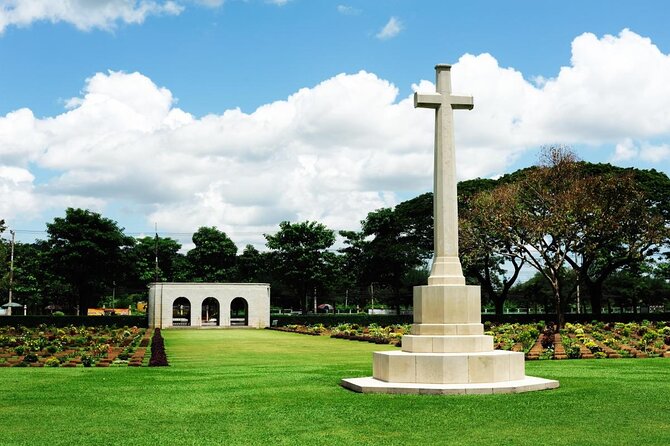
The first major stop is the Kanchanaburi War Cemetery, scheduled for about 40 minutes. It is the main prisoner-of-war cemetery for people who died during Japanese imprisonment and the construction of the Burma Railway.
The cemetery contains the graves of an estimated 9,000 Allied soldiers. Its neat rows and calm setting can be startling after the busy roads of Bangkok. This is not the place for a rushed explanation beside a bus. You need a little quiet time to read the inscriptions, notice the repeated ages, and understand that the railway story is made up of individual lives, not only military statistics.
Forty minutes is enough for a thoughtful visit, but not a long one. I would use the first few minutes to listen to the guide, then walk slowly through the grounds. If you are particularly interested in wartime history, you may wish the schedule allowed more time here.
The cemetery is also a useful counterweight to the bridge. The bridge is the famous image, but the graves make clear that the central story is human suffering. Keep your camera use respectful and give yourself time away from the group if the schedule allows.
The JEATH Museum and its direct presentation
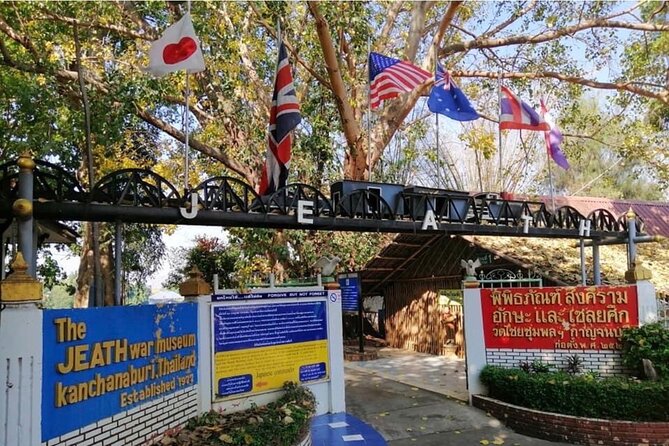
At about 9:40 a.m., you visit the JEATH War Museum for around 40 minutes. The museum was built in the form of a prisoner-of-war camp and contains paintings, photographs, and tools used during that period.
The setting helps you picture the cramped, improvised conditions described in the displays. It is not presented as a polished modern museum. That can be a strength if you prefer an immediate, plain account rather than a large institution with layers of interpretation.
The name JEATH refers to Japan, England, America, Australia, Thailand, and Holland, the countries connected with the wartime railway story. The displays provide background before you reach the bridge and train ride.
You should keep your expectations measured. The museum visit is fairly short, and the guide may repeat information already written on the walls. One useful way to approach it is to read the photographs and objects carefully instead of depending only on the spoken commentary. The paintings and old tools can help you understand the physical work involved, even if the explanation is brief.
I like the museum’s place in the schedule because it bridges the cemetery and the railway. I would not book this day solely for the museum. Its main role is to prepare you for the next stops.
Same city, a completely different afternoon:
- Bangkok: Damnoen Saduak Market and Maeklong Railway Market
★ 4.5 · 26,723 reviews - The Old Siam: Damnoen Saduak and Maeklong Railway Market
★ 4.5 · 10,992 reviews - From Bangkok: Ayutthaya Temples Guided Tour with Lunch
★ 4.7 · 10,535 reviews - Bangkok: Train Market & Floating Market with Boat Ride
★ 4.7 · 9,547 reviews
The River Kwai Bridge and its complicated fame
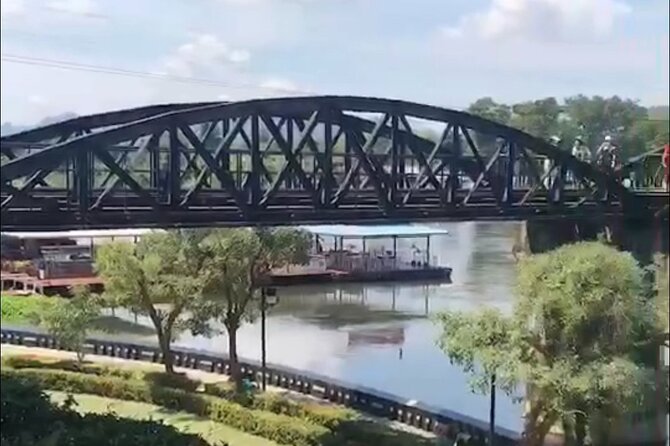
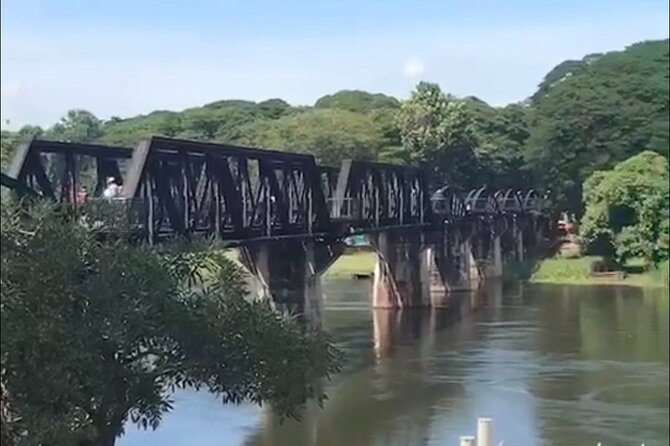
Around 10:30 a.m., the tour reaches the Bridge over the River Kwai for about 40 minutes. This is the most recognizable stop, and it draws attention partly because of the famous film that helped make the bridge known around the world.
The real value of the visit is not just crossing or photographing the structure. You are looking at part of a railway built during the war by prisoners of war and forced laborers under Japanese control. The bridge connects the popular image to the wider story you have already begun learning at the cemetery and museum.
A 40-minute visit gives you time to see the bridge and hear an explanation, though the exact amount of walking and waiting will depend on conditions. The bridge is an active historic site rather than a quiet memorial room, so you may find it more public and less reflective than the cemetery.
The annual Bridge of the River Kwai Memorial Week takes place in late November and early December, with exhibitions about the Second World War and the railway’s history. The tour information does not promise that you will attend the event, so treat it as seasonal background rather than a guaranteed part of the day.
I would keep your expectations grounded here. The bridge is important, but the train journey gives you a stronger sense of the route itself.
Riding the Death Railway toward Tham Kra Sae
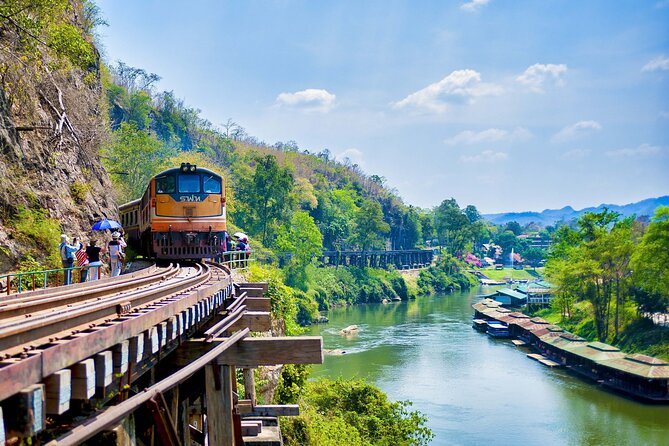
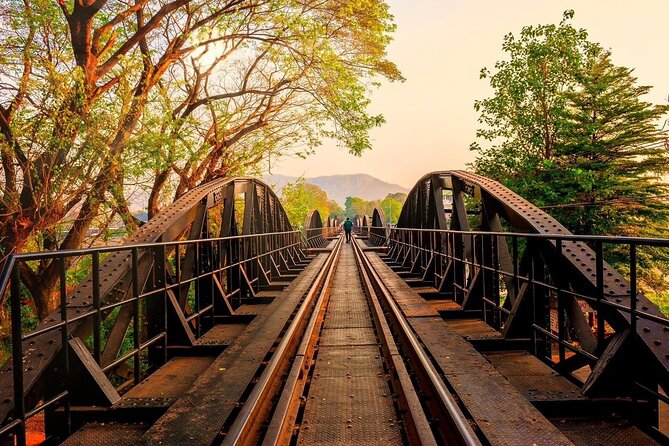
At about 11:15 a.m., you board the train for a journey lasting roughly two hours and 10 minutes. The route includes the Tham Kra Sae Bridge area and takes you along a striking section of the Death Railway.
This is the tour’s most distinctive activity. Instead of only viewing a memorial or reading a display, you travel on part of the railway connected to the story. The ride helps you see the route as a difficult engineering project, not an abstract line on a map.
The exact experience from the train windows will depend on the day, but the schedule describes this as a particularly scenic stretch. The railway runs toward the Burmese border, and the Wang Po station area is close to that direction. I would keep your camera ready while also paying attention to the guide’s historical comments.
The long train segment has two sides. It gives the day time to slow down after the museum and bridge, and the movement of the train can make the history feel more immediate. At the same time, two hours and 10 minutes is a substantial ride. If you dislike long periods of sitting, this may feel drawn out.
The railway is not a theme-park attraction. Its importance comes from the fact that it remains a working route built in wartime conditions. I would approach the ride with respect and curiosity, not expect a theatrical presentation.
Thai buffet lunch after the railway
A Thai buffet lunch is served at a restaurant in Kanchanaburi province after the train journey, around 1:40 p.m. The schedule places lunch near Wang Po station and says you depart for Bangkok at about 2:40 p.m.
Including lunch makes the day easier. You do not have to search for a restaurant between timed stops, and the meal gives you a proper break after the morning’s history and the train ride. The supplied details do not specify the exact dishes, drinks, or dietary arrangements, so I would ask the provider in advance if you have a strict dietary need.
Lunch is also where the tour’s group format matters. With no more than 10 people, the stop should be simpler to organize than a large coach meal. Still, the schedule allows about an hour, so do not expect a leisurely restaurant stay.
The inclusion adds value to the $109.60 price, but the real calculation is the whole package. You are paying for round-trip transport from Bangkok, an English-speaking guide, JEATH Museum admission, the Death Railway train ticket, and lunch. A person who values convenience may find that reasonable. Someone who wants only the bridge and a short train ride may find the price less attractive.
The long return to Bangkok
The return drive is listed as about four hours, departing Kanchanaburi at 2:40 p.m. and arriving back in Bangkok between 5:30 and 6:00 p.m. The timing is approximate, so traffic can affect the final arrival.
This is the main drawback and the point I would stress before booking. You leave Bangkok early, spend the morning moving between several historic sites, take a long train ride, eat lunch, and then face another lengthy road transfer. It is a full day in every sense.
The upside is that you see far more than you could comfortably arrange through a short outing. The downside is that Kanchanaburi itself receives only a limited part of the day outside the scheduled sites. If you want a relaxed stay in the province, this is not the right format.
I would avoid making evening plans that depend on a precise Bangkok arrival. The tour ends at the original meeting point, and a return window of 5:30 to 6:00 p.m. is useful but not a firm guarantee in city traffic.
What the $109.60 price really buys you
At $109.60 per person, this is not the cheapest possible way to reach Kanchanaburi. It can still be a fair price if you value a single booking that covers the main pieces of the day.
The included items are:
- Round-trip transfer from the Bangkok meeting point
- An English-speaking guide
- JEATH Museum admission
- Admission for the Death Railway train journey
- Thai buffet lunch
The cemetery and bridge entries are listed as free. Tips and gratitude are not included, so bring some extra cash if you want to thank the guide or driver.
The value is strongest for first-time visitors who do not want to coordinate regional transport, museum entry, train tickets, and lunch. The maximum group size of 10 also makes the price easier to justify than a large bus tour.
The value is weaker if you already have transport to Kanchanaburi or want to spend more time at one site. The itinerary moves quickly, and the guide’s contribution may be more logistical than scholarly. I would book it for structure and convenience, not for a private, highly personalized history lesson.
Who should book this Kanchanaburi day trip
I would recommend this tour to you if you have limited time in Thailand and want the main Second World War sites outside Bangkok in one organized day. It suits people who appreciate a clear schedule, included transport, and a small group.
It is especially fitting if you want the cemetery and railway treated as connected parts of the story. The combination is more worthwhile than a bridge photo stop on its own.
You should think twice if you dislike early mornings, long vehicle rides, or fixed meal and departure times. The tour is also less suitable if you want extensive time for personal research at the museum or a quiet, unhurried visit to the cemetery.
The experience can be thought-provoking, but some of the emotional weight comes from the places themselves, not from elaborate guiding. One of the strongest responses described the trip as profoundly thought-provoking because it made the scale and conditions of the railway’s construction easier to understand. That is the right reason to go.
Booking, group size, and cancellation details
Confirmation is received at booking, and the meeting point is near public transport at Century Park Hotel Pratunam, close to Victory Monument. Most people can take part, and the group is limited to 10.
Free cancellation is available if you cancel at least 24 hours before the experience starts. Changes or cancellations made within 24 hours are not accepted for a refund. The local cutoff time applies.
The experience requires good weather and a minimum number of participants. If poor weather or insufficient numbers cause cancellation, you are offered another date or experience, or a full refund.
Should you book it?
Book this full-day trip if you want the most important Kanchanaburi stops in one package, especially the cemetery, JEATH Museum, River Kwai Bridge, and Death Railway train. The small group, included lunch, and covered admissions make the day easy to manage from Bangkok.
Skip it if you want a slow provincial getaway or expect expert-level historical commentary at every stop. The guide may keep close to the museum material, and the long return drive demands patience.
For the right person, this is a useful and sobering day trip. Go for the cemetery and the railway first, the famous bridge second, and the convenience of having the whole route arranged around them.
FAQ
Where does the tour start and finish?
The tour starts at Century Park Hotel Pratunam, Victory Monument, 9 Ratchaprarop Road in Bangkok. It ends back at the same meeting point.
What time does pickup begin?
Pickup starts between 6:00 and 7:00 a.m. The schedule is approximate, so you should be ready during that window.
How long is the tour?
The experience lasts approximately 13 hours. The planned return to Bangkok is between 5:30 and 6:00 p.m.
What is included in the price?
Round-trip transfer, an English-speaking guide, JEATH Museum admission, the Death Railway train journey, and a Thai buffet lunch are included.
Is the tour limited to a small group?
Yes. The activity has a maximum of 10 participants.
Can I cancel for a full refund?
Yes, if you cancel at least 24 hours before the experience start time. Cancellations or changes made less than 24 hours before the start are not accepted for a refund.
Just added around Bangkok
- Bangkok: Fallabella River Front Iconsiam★ 4.7 · 3 reviews
- Private Grand Palace Bangkok City Tour & Klong Longtail Boat Trip★ 4.5 · 3 reviews
- Bangkok: Divana Scentuara Spa Chidlom Branch E-Voucher★ 5.0 · 3 reviews
- Bangkok: Flower Market & Sunset Walking Tour★ 3.7 · 3 reviews
- Private Shore Excursion: Best of Bangkok in a day★ 3.5 · 3 reviews
- From Bangkok: Kanchanaburi, River Kwai and Erawan Waterfall Tour★ 3.0 · 3 reviews
- Private Damnoen Saduak and Maeklong Railway Market Tour(min 2pax)★ 5.0 · 3 reviews
- Damnoen Saduak Famous Floating Market and Mea Klong Railway Tour★ 5.0 · 3 reviews
Full-Day, compared.

Bangkok by Private Guide: Full Day Tour In and Around
Read our review →
UNESCO’s Ayutthaya Historical Park: Full-Day Tour from Bangkok
Read our review →
Historical City of Ayutthaya – Unesco Full Day Tour From Bangkok
Read our review →
Khao Yai National Park Full-Day From Bangkok – Including Ticket
Read our review →
Kanchanaburi Full Day Tour: River Kwai and Erawan Falls
Read our review →
Full Day Bangkok PRIVATE City Tour With Locals – Wat Trimit & Wat Pho tickets
Read our review →
Private Bangkok City Tour Full Day With The Grand Palace
Read our review →