
Reviewed · MARKETS
Flower Market & Floral Art: Multilingual Private Tour [EN/others]
Bangkok’s flower market is only the opening act here. You move from piles of jasmine and lotus blossoms at Pak Khlong Talad to hands-on flower making, a river ferry, a Thai-Chinese temple, and the old Portuguese quarter of Kudi Chin. I love the local flower workshops and the way this tour connects daily commerce with religious practice. I also like the private format, which lets your guide slow down for questions, children, photos, or a cold drink.
The main caution is that the floral-art portion needs a good guide and clear planning. One guest found the workshop much smaller than expected when paired with a first-time guide, while other outings led by Nina or Nine were praised for their care and flexibility. At about $95.17 per person, the value depends on getting the full program and having enough time for both workshops.
In This Review
- Key points to know before booking
- Why this four-hour tour feels different from a standard Bangkok outing
- Pak Khlong Talad: Bangkok’s flower market at close range
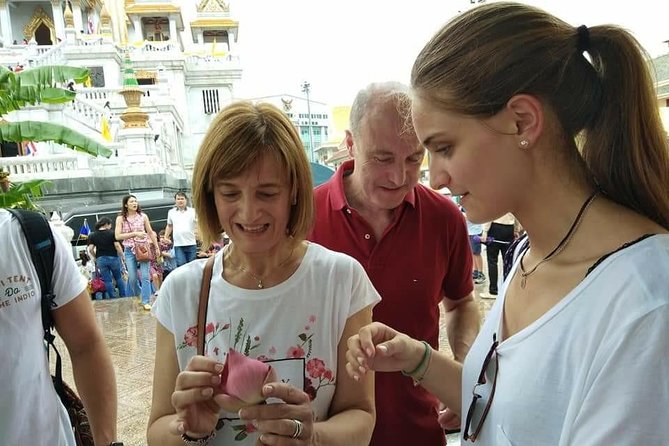
- Folding lotus flowers beside a local seller
- Crossing the river to Wat Kalayanamitr
- Wat Kalayanamitr and the Sam Por Kong Buddha
- The one-hour jasmine garland workshop
- Guanyin Shrine and the Chinese side of Bangkok
- Santa Cruz Church and the Kudi Chin neighborhood
- Baan Kudi Chin Museum and a local snack
- Timing, transport, and the practical details
- Who will get the most from this experience
- My verdict on the $95.17 price
- Should you book this flower and heritage tour?
- FAQ
- How long does the Flower Market and Floral Art tour last?
- What language options are available?
- Is this a private tour?
- What flower activities are included?
- Is admission to Baan Kudi Chin Museum included?
- Is transportation included?
- Is lunch included?
- Can I cancel for a full refund?
Key points to know before booking
![Flower Market & Floral Art: Multilingual Private Tour [EN/others] - Key points to know before booking](https://3.lovingbangkok.com/wp-content/uploads/flower-market-floral-art-multilingual-private-tour-en-others-1.jpg)
- Pak Khlong Talad comes first: See Bangkok’s original and largest flower market, where local florists buy fresh stock.
- Two different flower activities: Fold cone-shaped and ball-shaped lotuses with a local seller, then make Thai jasmine garlands with skilled artisans.
- A short ferry ride adds variety: Cross the river to Wat Kalayanamitr and feed fish at the pier as a traditional merit-making act.
- The temple visit is more than a photo stop: See the large golden Sam Por Kong Buddha and the blend of Thai and Chinese Buddhist traditions.
- Kudi Chin adds a quieter side of Bangkok: Visit Guanyin Shrine, Santa Cruz Church, and Baan Kudi Chin Museum.
- Private and multilingual: English, Spanish, Italian, German, French, and Chinese guide options are available, with morning or afternoon departures.
Why this four-hour tour feels different from a standard Bangkok outing
I like tours that use a familiar subject to open a door into local life. Flowers do that well in Bangkok. They are sold by the sack at the market, folded for temple offerings, woven into jasmine garlands, and tied to family and neighborhood traditions.
This is not simply a market walk followed by a few temples. You get to handle the flowers yourself, then see how they fit into Buddhist worship and community life. The Portuguese heritage of Kudi Chin gives the day another layer, with Santa Cruz Church and a museum devoted to the Siam-Portuguese families who remain in the area.
The private format matters. You are not attached to a large group moving at one speed. A guide can explain an unfamiliar ritual, adjust the pace for your children, or make time for a drink when Bangkok’s heat catches up with you. One guide, Nina, was praised for adding ice cream and cold drinks for a family with two children, ages nine and eleven. That sort of flexibility is one of the strongest reasons to pay more for a private outing.
The tour is listed at $95.17 per person. That is not a bargain-priced market visit, but the fee includes a licensed multilingual guide, private air-conditioned hotel transfer, both flower workshops, museum admission, the ferry portion, and travel accident insurance. For a couple or small family, the price can make sense if you want a planned cultural experience without arranging several short trips yourself.
More market visits in Bangkok:
- Bangkok: Damnoen Saduak Market and Maeklong Railway Market
★ 4.5 · 26,723 reviews - The Old Siam: Damnoen Saduak and Maeklong Railway Market
★ 4.5 · 10,992 reviews - Bangkok: Train Market & Floating Market with Boat Ride
★ 4.7 · 9,547 reviews
Pak Khlong Talad: Bangkok’s flower market at close range
![Flower Market & Floral Art: Multilingual Private Tour [EN/others] - Pak Khlong Talad: Bangkok’s flower market at close range](https://3.lovingbangkok.com/wp-content/uploads/flower-market-floral-art-multilingual-private-tour-en-others-2.jpg)
The first stop is Pak Khlong Talad, Bangkok’s original and largest flower market. You have about 30 minutes here, so expect a focused introduction rather than hours of wandering.
The market’s appeal is its working character. Local florists come to buy fresh flowers, and the range of produce is broad. Jasmine is especially important to this tour, but you can also expect to see lotus flowers and other blooms prepared for sale and religious use.
The smell can be strong. One guest singled out the pungent jasmine fragrance, which is a fair warning if you prefer carefully scented tourist attractions. Here, the flowers are part of an active trade, not a staged display.
Your guide’s explanation is useful because the market can be hard to read on your own. You may see flowers being sorted, bundled, and prepared without knowing what they are used for. The guide can connect those flowers to Thai offerings, garlands, and temple customs.
Thirty minutes is enough to get a feel for the place, take photos, and begin the workshop. It is not enough for a leisurely market study. If the market is the part you most want to explore, keep that limit in mind.
Folding lotus flowers beside a local seller
The first workshop lasts about 20 minutes and takes place at the flower market with a local lotus seller. You learn to fold Bua Luang, a cone-shaped lotus, and Bua Chut, a ball-shaped lotus.
This is a simple activity, but it gives you a better understanding of the care behind temple offerings. The folded lotuses are brought to a Buddha image as an act of respect. Instead of only watching someone arrange flowers, you take part in a small ritual practice.
I would expect this session to feel informal and hands-on rather than like a formal craft class. Twenty minutes is enough to learn the basic folds, but not enough to become an expert. The private setting should help if your first attempt looks more like a crushed paper cup than a lotus.
Families may find this the easiest part of the tour for children. It has a clear result, does not require a long explanation, and gives young participants something to do with their hands. The second workshop is longer and more involved, so this short market session works well as an introduction.
Crossing the river to Wat Kalayanamitr
![Flower Market & Floral Art: Multilingual Private Tour [EN/others] - Crossing the river to Wat Kalayanamitr](https://3.lovingbangkok.com/wp-content/uploads/flower-market-floral-art-multilingual-private-tour-en-others-4.jpg)
The itinerary includes a ferry ride to Wat Kalayanamitr, followed by about ten minutes at the pier to feed fish. Thai people regard fish feeding as a merit-making act, connected with hopes for a fertile and prosperous life.
The ferry adds a welcome change of pace. You get a brief river view and a chance to cool off before the temple visit. A guest described the river crossing as breezy, which makes sense as a practical break from the heat and traffic of central Bangkok.
This part is short, so do not treat it as a sightseeing cruise. The point is the transfer, the river setting, and the local meaning of feeding fish. Your guide can explain why an ordinary action at the pier carries religious significance.
The meeting point is Rajini School at 444 Thanon Maha Rat. The tour ends back at the meeting point, and private air-conditioned vehicle transfer to the hotel is included. Confirm the pickup arrangement when booking, since the published meeting point and the included transfer serve different parts of the day.
A few more Bangkok half-days to weigh up
- From Bangkok: Ayutthaya & Ayothaya Floating Market Day Trip
★ 4.7 · 6,084 reviews - Bangkok: City Highlights Temple and Market Walking Tour
★ 4.5 · 3,990 reviews - Half-Day Railway Market and Floating Market Tour in Thailand
★ 4.5 · 3,924 reviews - Bangkok: Damnoen Saduak, Train Market & Mahanakhon Day Trip
★ 4.7 · 2,162 reviews
Wat Kalayanamitr and the Sam Por Kong Buddha
![Flower Market & Floral Art: Multilingual Private Tour [EN/others] - Wat Kalayanamitr and the Sam Por Kong Buddha](https://3.lovingbangkok.com/wp-content/uploads/flower-market-floral-art-multilingual-private-tour-en-others-5.jpg)
Wat Kalayanamitr gives you about 20 minutes inside the temple. Its religious character combines Thai and Chinese Buddhist traditions, which fits the wider theme of this tour: Bangkok as a city shaped by many communities and customs.
The central sight is Sam Por Kong, one of the largest golden Buddha images in Bangkok. The visit is primarily for paying respects, not for racing through a long checklist of buildings. Dress and behave with the care expected at an active temple.
Twenty minutes is brief, but the stop works because the guide has already introduced flower offerings. You can see how the lotuses you folded connect to a real place of worship. That link gives the craft activity more meaning than a stand-alone souvenir workshop.
The temple stop may feel short if you want detailed architecture or quiet personal time. On the other hand, it keeps the day moving and leaves an hour for the main garland workshop, which is the heart of the program.
The one-hour jasmine garland workshop
![Flower Market & Floral Art: Multilingual Private Tour [EN/others] - The one-hour jasmine garland workshop](https://3.lovingbangkok.com/wp-content/uploads/flower-market-floral-art-multilingual-private-tour-en-others-6.jpg)
The longest stop is a one-hour floral handicraft workshop with Thai artisans from the Kudi Khow community. Here you learn to make Thai jasmine garlands, an important cultural skill that requires more patience than the quick lotus folding session.
This is where the tour’s social purpose becomes clear. The operator hires floral artisans from the local community, including residents who have had limited access to formal work. Your fee supports a practical skill and the people who keep it alive.
Jasmine garlands are often used for offerings and acts of respect. Making one yourself helps you notice the detail involved: selecting flowers, arranging them, and keeping the form neat. The work is repetitive in a calming way, though anyone expecting a fast craft demonstration should adjust their expectations.
Allow the full hour. The negative experience described for this tour involved receiving only a small amount of floral art, so it is reasonable to confirm the workshop schedule at the start. Ask your guide when the garland session will begin and what you will make. This is especially important if the flower workshop is your main reason for booking.
The guide makes a real difference here. Nina and Nine are names associated with especially warm, organized guiding on this experience. Availability cannot be guaranteed, but you can request a preferred guide or language when you book.
Guanyin Shrine and the Chinese side of Bangkok
![Flower Market & Floral Art: Multilingual Private Tour [EN/others] - Guanyin Shrine and the Chinese side of Bangkok](https://3.lovingbangkok.com/wp-content/uploads/flower-market-floral-art-multilingual-private-tour-en-others-7.jpg)
The short stop at San Chao Kian An Keng takes about ten minutes. This Guanyin Shrine dates to the reign of King Taksin, roughly 230 years ago, and contains a Guanyin statue with a form that differs from those commonly seen at other shrines.
Ten minutes does not allow for a long visit, but it gives you a useful bridge between Wat Kalayanamitr and Kudi Chin. The area reflects Bangkok’s Chinese influence, while the next stop shows the Portuguese connection.
The shrine is best treated as a compact introduction. Listen closely to the guide’s explanation, since the detail about the statue and its place in the shrine’s tradition may be easy to miss if you are moving independently.
Santa Cruz Church and the Kudi Chin neighborhood
![Flower Market & Floral Art: Multilingual Private Tour [EN/others] - Santa Cruz Church and the Kudi Chin neighborhood](https://3.lovingbangkok.com/wp-content/uploads/flower-market-floral-art-multilingual-private-tour-en-others-8.jpg)
From the temple area, you walk toward Santa Cruz Church, also known as Kudi Chin. The stop lasts around ten minutes and focuses on the Portuguese presence in Thailand.
The church was built after King Taksin granted land to Portuguese people. That fact helps explain why a Portuguese Catholic church sits within a part of Bangkok otherwise associated with Buddhist temples and Chinese shrines.
This is a short walk and a short visit, not a full church tour. The value lies in seeing the neighborhood connections. Within a small area, the route moves among Thai Buddhist, Chinese, and Portuguese traditions.
I appreciate this section because it keeps the tour from becoming a single-theme flower activity. You begin with a commercial market, then see religious offerings, Chinese worship, and Portuguese Catholic heritage. The result is a more rounded picture of Bangkok’s old communities.
Baan Kudi Chin Museum and a local snack
The final major stop is Baan Kudi Chin Museum, with about 20 minutes inside. The museum explains the history, religion, and food traditions of the Siam-Portuguese community that still lives in the area.
Admission is included, and you have a chance to try a Kudi Chin snack. That small tasting is useful because food often explains cultural exchange better than a plaque does. The museum gives context to Santa Cruz Church and to the community around it.
Twenty minutes is enough for a compact introduction but not an exhaustive museum visit. The museum is closed on Mondays, so do not book this experience for that day if the museum is important to you. The rest of the tour may still operate, but the advertised museum portion will not be available.
The museum also gives the day a quieter ending. After the market, ferry, temple, and workshops, you are looking at objects and stories from a community that continues to live in the neighborhood.
Timing, transport, and the practical details
The experience lasts about four hours, with a morning or afternoon option. That choice helps you fit the tour around other Bangkok plans, though heat and energy levels may influence which departure works better for you.
The meeting point is Rajini School on Thanon Maha Rat. The activity ends back there. Private air-conditioned vehicle transfer for the hotel is included, and the route itself includes a ferry ride and walking between nearby sights.
You should be comfortable walking and standing. The operator says the tour is not recommended for people with walking difficulty, although most people can participate and service animals are allowed. The market, temple grounds, neighborhood lanes, pier, and workshops all require movement.
Lunch is not included. You self-order and pay for it, so plan to eat before or after the tour rather than expecting a provided meal. The itinerary includes a snack at the museum, but that is not a substitute for lunch.
The tour is private, so only your own group participates. Guide options include English, Spanish, Italian, German, French, and Chinese. Confirmation arrives at booking, and cancellation is free if you cancel at least 24 hours before the local start time. Late cancellations and changes are not accepted.
Who will get the most from this experience
I would choose this tour if you want Bangkok culture explained through ordinary actions rather than only grand monuments. It suits couples, families, and small groups who enjoy crafts, local neighborhoods, and short visits to several religious sites.
Children can take part in both flower activities, and the private guide can adjust the rhythm. The family experience with Nina included extra stops for ice cream and cold drinks, a useful sign that the format can work well for younger visitors when the guide is attentive.
It is also a good choice for a repeat visitor who has already seen Bangkok’s major temples. Pak Khlong Talad and Kudi Chin show parts of the city that are easy to miss if you stay on the standard sightseeing route.
You may want another tour if you want a long market visit, serious temple photography, or a full-day craft course. The market visit is only 30 minutes, the temple stops are short, and the overall route covers several subjects in four hours.
My verdict on the $95.17 price
At $95.17 per person, this is best viewed as a private cultural outing rather than a cheap attraction ticket. You are paying for a guide, transport support, both workshops, museum admission, the ferry portion, and the convenience of a planned route.
The strongest value comes from the one-hour garland workshop and the private attention. If your group asks questions, needs a flexible pace, or wants cultural context, the price is easier to justify. A large part of the experience would be harder to arrange independently, especially the artisan workshop.
The weak point is consistency. One first-time guide did not provide the amount of floral art promised, while other guides, including Nina and Nine, received strong praise for being friendly and adaptable. Confirm the workshop details early, and tell the operator that floral instruction is your priority.
Should you book this flower and heritage tour?
Book it if you want to make lotus flowers and jasmine garlands, see a working flower market, and connect Bangkok’s Buddhist, Chinese, and Portuguese communities in one half-day route. The private format, multilingual guide choices, and family-friendly pace make it more personal than a standard group sightseeing trip.
Skip it if you mainly want extended time at Pak Khlong Talad or a detailed architectural tour. For everyone else, this is a thoughtful way to spend four hours, provided you confirm that both floral workshops are firmly included and avoid Monday if Baan Kudi Chin Museum matters to you.
FAQ
How long does the Flower Market and Floral Art tour last?
The tour lasts approximately four hours.
What language options are available?
Licensed guides or interpreters are available in English, Spanish, Italian, German, French, and Chinese, depending on the option purchased.
Is this a private tour?
Yes. Only your own group participates in the activity.
What flower activities are included?
You learn to fold Bua Luang, a cone-shaped lotus, and Bua Chut, a ball-shaped lotus, with a local lotus seller. You also take part in a Thai jasmine garland workshop with local artisans.
Is admission to Baan Kudi Chin Museum included?
Yes, museum admission is included. The museum is closed on Mondays.
Is transportation included?
Private air-conditioned vehicle transfer for the hotel is included. The route also includes a ferry ride to Wat Kalayanamitr. The listed meeting point is Rajini School, and the tour ends back at that meeting point.
Is lunch included?
No. Lunch is self-ordered and paid for separately.
Can I cancel for a full refund?
Yes, if you cancel at least 24 hours before the experience start time. Cancellations or changes made less than 24 hours before the start are not accepted and are not refunded.
Just added around Bangkok
- Yoga in the Park Thailand★ 5.0 · 12 reviews
- Bangkok and Ayutthaya 3 Days★ 4.5 · 12 reviews
- Private Tour: Damnoen Saduak Floating Market and Bangkok City Temples★ 5.0 · 12 reviews
- Chinatown (Yaowarat Road) Neon Photoshoot★ 5.0 · 12 reviews
- Ayutthaya Day Tour By Coach and Cruise★ 4.0 · 12 reviews
- Bangkok Suvarnabhumi Airport: VIP Meet & Greet Service (Fasttrack)★ 3.5 · 12 reviews
- Bangkok: Wow Park Interactive Amusement & Science Park★ 4.5 · 12 reviews
- Afternoon Ayutthaya & Ancient Temples at UNESCO site By Road★ 4.5 · 12 reviews
Markets, compared.

Damnoen Saduak Market and Maeklong Railway Market
Read our review →
The Old Siam: Damnoen Saduak and Maeklong Railway Market
Read our review →
Train Market & Floating Market with Boat Ride
Read our review →
Ayutthaya & Ayothaya Floating Market Day Trip
Read our review →
City Highlights Temple and Market Walking Tour
Read our review →
Half-Day Railway Market and Floating Market Tour in Thailand
Read our review →
Damnoen Saduak, Train Market & Mahanakhon Day Trip
Read our review →
Browse the lists this tour appears in