
Reviewed · SCOOTER RENTALS
Electric Scooter Tour of Bangkok
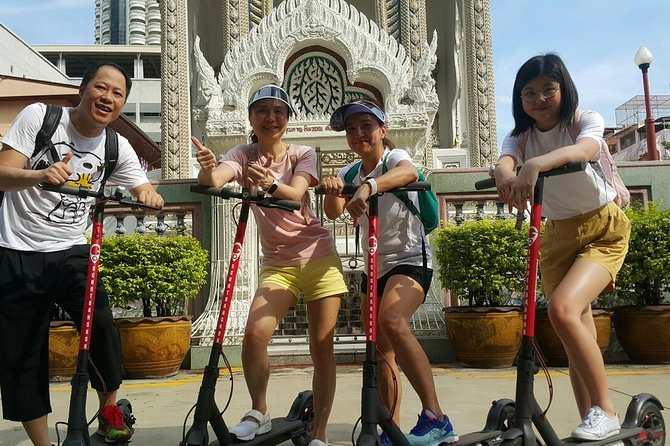
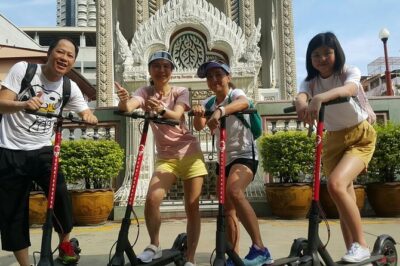
Bangkok reveals itself best from the lanes between its famous sights, and this small-group electric scooter tour gets you into those narrow corners without putting you on a bus. You ride from Bang Rak through Talad Noi, Chinatown, flower markets, temples, and old Thonburi, then cross the river by ferry.
I like the tiny group, capped at three, because it gives your guide room to adjust the pace and answer questions. I also like the mix of places: a mosque, Chinese and Portuguese communities, a wholesale flower market, and temples with unusual details such as crocodiles and a giant bell. The main caution is that guide commentary may vary. One tour was praised for Nic’s flexible guidance, while another guest found the guide too quiet and offered little explanation.
In This Review
- Key points before you book
- Why a scooter works well in Bangkok
- Starting in Bang Rak and getting comfortable
- Bang Rak’s postal building and Haroon Mosque
- Talad Noi, street art, and old commercial Bangkok
- A quick ride through Chinatown
- Wat Chakrawatrachawat and its crocodiles
- Pak Khlong Flower Talat after the ride
- Crossing the river to Wat Kalayanamit
- Baan Kudichin and Bangkok’s Portuguese past
- Lhong 1919 and the final possibilities
- The guide can shape the whole experience
- What the $36.58 price includes
- Morning or afternoon, and what to wear
- Who should book this Bangkok ride?
- Should you book the Electric Scooter Tour of Bangkok?
- FAQ
- How long does the electric scooter tour last?
- Where does the tour start?
- Where does the tour end?
- Is hotel pickup included?
- How many people can join?
- Can I choose a morning or afternoon departure?
- What age is required to ride?
- Is there a height requirement?
- Is there a weight limit?
- Are helmets and insurance included?
Key points before you book
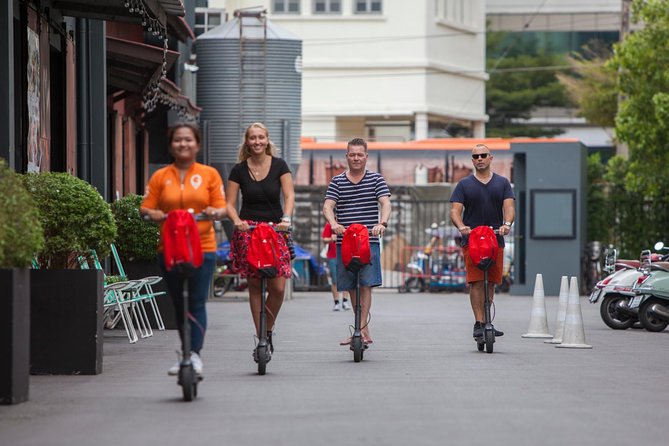
- Ride through old Bangkok lanes: The route favors alleys, footpaths, markets, and small communities over standard bus-tour stops.
- Group size is capped at three: This is a personal format, not a large convoy.
- The river crossing is part of the trip: You take a local ferry from the flower market to Wat Kalayanamit.
- Allow time to learn the scooter: Practice begins in Bang Rak before the ride starts, and training can take a meaningful part of the morning or afternoon.
- Expect a broad cultural route: You pass mosques, churches, temples, Chinese sites, Portuguese heritage, and local markets.
- Snacks and drinks are included: Bottled water, coffee or tea, and snacks await you during or after the ride.
Why a scooter works well in Bangkok
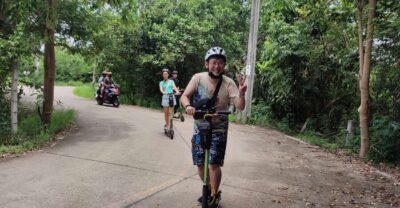
A bus can take you to Bangkok’s headline sights, but it cannot easily enter the back streets that connect them. An electric scooter gives you a middle ground between walking and riding in a vehicle. You cover more ground than you would on foot, yet you remain close to street life.
The route begins in Bang Rak, one of Bangkok’s oldest districts, and then threads through Talad Noi, Chinatown, and the river communities. That matters because Bangkok’s character often changes within a few blocks. A busy market can give way to a quiet religious compound, then a lane lined with old homes.
You should not expect a nonstop speed run. The first part is scooter practice, and the route includes pauses at temples, markets, and heritage sites. The tour lasts about three hours, though the operator has described a four-hour version in one response and noted that training alone can take close to an hour. If you have a flight, reservation, or fixed afternoon plan, leave a generous buffer.
A few more Bangkok half-days to weigh up
- Bangkok: E-Scooter Night Tour with Local Street Food
★ 4.8 · 488 reviews - Bangkok: Bang Kachao E-Scooter Jungle Tour
★ 4.8 · 154 reviews - Bangkok: Riverside E-Scooter Adventure with StreetFood Snack
★ 4.9 · 133 reviews
Starting in Bang Rak and getting comfortable
You meet at Thai Cooking School, 69, 2 Soi Charoen Krung 44 in Bang Rak. The activity returns to this same meeting point, so you do not need to arrange a second pickup across town.
The first stop is not really a sightseeing stop. It is a practice area where you learn to handle the electric scooter before entering the streets. This is useful, especially if you have never used this type of scooter. It also explains why the actual route may feel shorter than the total time suggests.
I would treat the practice as part of the value, not as lost time. Bangkok traffic and crowded lanes are not the place to learn while moving. The minimum age is 12, riders must be at least 140 centimeters tall, and the maximum listed weight is 120 kilograms. Helmets and insurance are included.
Bang Rak’s postal building and Haroon Mosque
The route then reaches the Grand Postal Building, a former post office now used as a cultural center. You spend only about five minutes here, so this is more of a quick architectural and neighborhood orientation point than a full visit.
Next comes Haroon Mosque, one of Thailand’s early mosques. It sits in the old town amid a long-established local community, and the stop gives the route a welcome change of subject. This is not a tour focused only on royal monuments and famous Buddhist temples. You see how several faiths and communities have shaped Bangkok.
The planned stop is short, around two minutes. If you want detailed religious or architectural discussion, ask your guide directly. The small group makes that possible, and the quality of the explanation will matter here.
Talad Noi, street art, and old commercial Bangkok
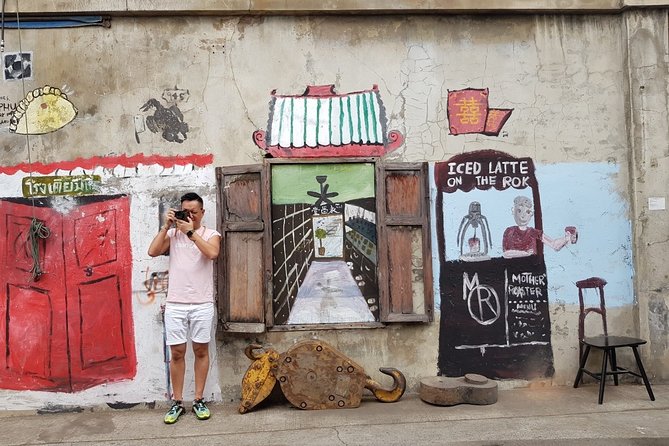
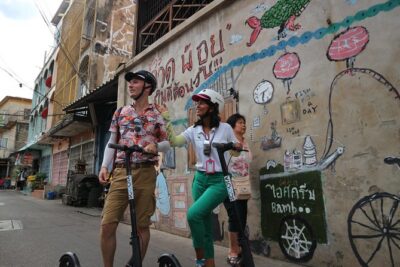
Talad Noi is one of the more appealing sections of the ride. You move through back streets and alleys where wall art shares space with older homes and signs of Bangkok’s trading past. The area is also linked with one of the city’s early churches and Siam Commercial Bank, described as Thailand’s first bank.
About 20 minutes is set aside here, enough for a closer look and some photos. The route is valuable because you are not simply viewing Talad Noi from a main road. You are moving through the smaller passages that connect the neighborhood.
Street art is part of the draw, but do not book this expecting a dedicated mural tour. One critical assessment specifically wanted more information about street art and found the guide’s commentary thin. That is a useful warning: the physical route has plenty to see, but your enjoyment will depend on how actively the guide explains what you are passing.
Same city, a completely different afternoon:
- Bangkok: Damnoen Saduak Market and Maeklong Railway Market
★ 4.5 · 26,723 reviews - The Old Siam: Damnoen Saduak and Maeklong Railway Market
★ 4.5 · 10,992 reviews - From Bangkok: Ayutthaya Temples Guided Tour with Lunch
★ 4.7 · 10,535 reviews - Bangkok: Train Market & Floating Market with Boat Ride
★ 4.7 · 9,547 reviews
A quick ride through Chinatown
Bangkok’s Chinatown is described as one of the world’s largest, and the route passes through its maze of streets linking different parts of the district. It is included as a moving section rather than a long formal stop.
That arrangement makes sense for a three-hour tour. Chinatown can absorb an entire morning on its own, especially if you stop to eat or shop. Here, you get a taste of its scale and street energy without losing the rest of the route.
You should not count on a long food break in Chinatown. The tour includes snacks and a beverage, but it does not promise a meal. If food is your priority, plan another visit when you can explore the market at your own pace.
Wat Chakrawatrachawat and its crocodiles
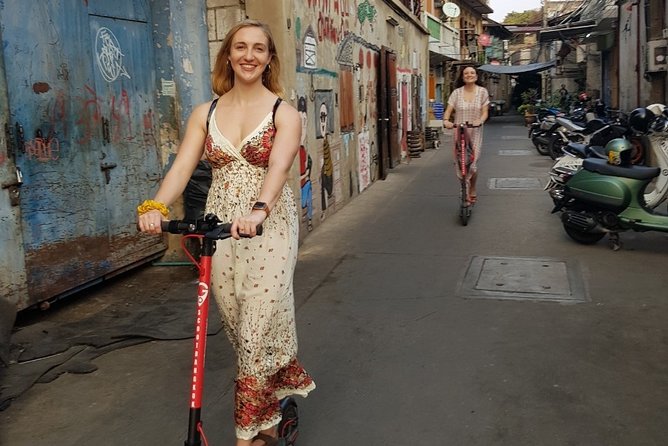
Wat Chakrawatrachawat Woramahawihan dates from the 1800s and has an unusual feature: crocodiles. The temple once kept them as a way to protect them from being captured and killed by river traders.
The planned visit lasts about ten minutes. This is a good example of the tour’s appeal. You are not only ticking off a famous wat. You are getting a small story that gives the place a reason to remember it.
As with the other temple stops, wear suitable clothing. The stated dress code is temple attire, so cover shoulders and knees and choose clothing that will be respectful at religious sites. The tour includes the use of a helmet, but you are responsible for arriving dressed appropriately.
Pak Khlong Flower Talat after the ride
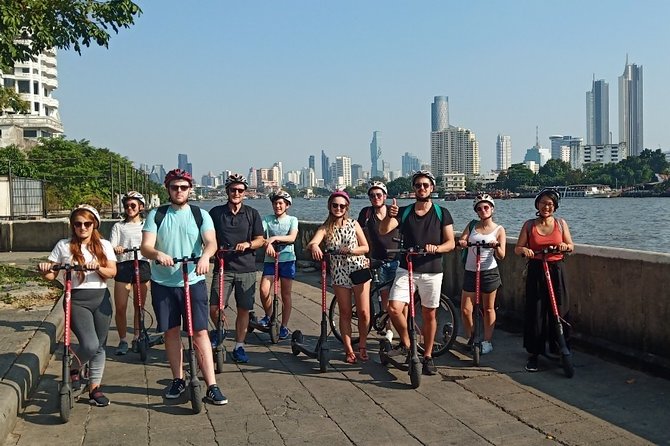
Pak Khlong Flower Talat is Thailand’s largest wholesale market for flowers, spices, and vegetables. It operates around the clock, but the main flower-selling streets become especially active in the evening.
The planned stop is about ten minutes. That is enough to see the market’s colors and smells, but not enough for a leisurely browse through every lane. If you take the afternoon departure, the timing may give you a better chance of seeing the flower trade at its liveliest, though the supplied schedule does not guarantee a particular market scene.
You can also return on your own for a longer visit. That is one of the practical strengths of this route: it points you toward places worth revisiting rather than pretending a short stop can cover everything.
Crossing the river to Wat Kalayanamit
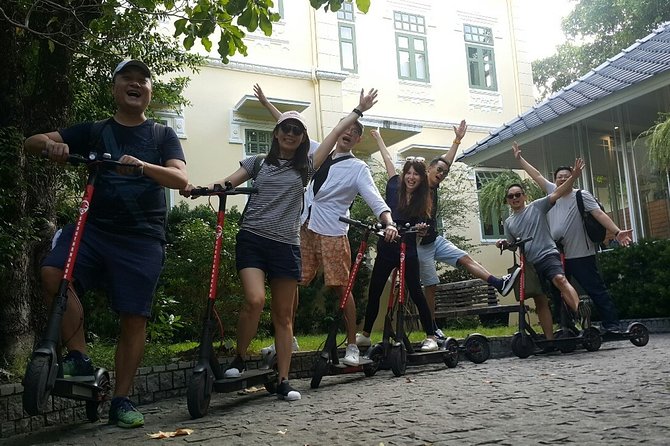
From the flower market, you cross the river by ferry to Wat Kalayanamit Woramahawihan. The ferry is not just transport between stops. It gives you a local-scale river crossing and a change of view before you reach historic Thonburi.
The temple is known here for one of Thailand’s largest seated Buddhas and its large bell. The guide also introduces Buddhist customs at the site. Fifteen minutes is scheduled, so expect an orientation and a look around rather than a long temple visit.
This is one of the route’s strongest transitions. You move from the commercial world of flowers and produce into a temple compound across the water, then continue into communities with Portuguese and Chinese roots.
Baan Kudichin and Bangkok’s Portuguese past
Baan Kudichin is a Portuguese settlement that remains active today. The stop includes a museum, coffee shops, and a bakery known for cookies made in a tradition introduced more than 200 years ago.
The schedule gives you around 20 minutes here, one of the longer pauses. That extra time is welcome because the area offers more than a quick photograph. You have room to look at the museum and sample the local food culture if the arrangements and timing allow.
I especially like this part for visitors who want Bangkok beyond royal palaces and large temples. The city’s story includes migration, trade, religion, and family communities, and Baan Kudichin makes those themes easier to see in a compact place.
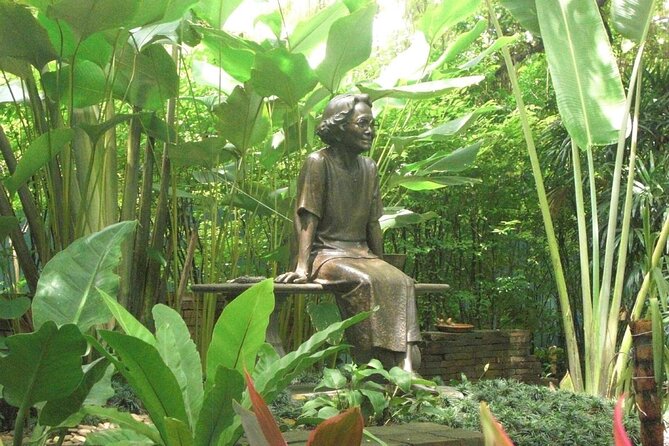
The route also notes another site within the Portuguese settlement, though no separate stop time is given. A park dedicated to the mother of King Rama IX may be added if time permits. Treat both as possible extras, not guaranteed stops.
Lhong 1919 and the final possibilities
Lhong 1919 was once connected with Chinese immigration and is now a complex with restaurants, shops, and old murals that are easy to overlook. A ten-minute stop is listed if time permits.
That wording is important. The route is broad, and timing can change because of scooter practice, traffic, ferry schedules, or the time spent at earlier sites. Lhong 1919 may be included, but you should not make your booking decision solely on the promise of this final stop.
The tour ends back at the Bang Rak meeting point. There is no hotel pickup or hotel drop-off, so you need to make your own way there and back. The start point is near public transportation, which helps, but the exact ease of your journey depends on where you are staying.
The guide can shape the whole experience
A three-person maximum creates the chance for excellent guiding. You can ask why a neighborhood has a particular mix of buildings, pause for a question, or request a little more time at a market. Nic is specifically praised for being adaptable and well informed during one outing.
Still, the guiding is the biggest variable. A separate experience left one guest disappointed because the guide spoke very little and gave scant information about the places along the way. The operator’s response focused on the long training period and the care taken with that private outing, but it did not erase the concern about commentary.
My practical advice is simple: ask questions from the beginning. If you want street-art details, temple customs, food suggestions, or neighborhood history, say so. The small group gives you a better chance of getting the tour you want, but you should not assume the guide will deliver a long explanation at every stop.
What the $36.58 price includes
At $36.58 per person, the price is reasonable for a three-hour guided outing if you value access to small lanes and a tiny group. You are paying for a guide, scooter use, helmet, insurance, ferry-related routing, bottled water, coffee or tea, snacks, and the operator’s fees.
The strongest value is not any single landmark. It is the combination of transport and local orientation. You can visit Wat Kalayanamit, the flower market, or Chinatown independently, but seeing them in one connected route saves planning time and lets you understand how the districts relate to one another.
The value is less clear if you mainly want detailed lectures or long visits inside major attractions. Several stops are brief, and some possible additions depend on time. You also pay separately for alcohol, and hotel transport is not included.
The tour is booked an average of 19 days ahead, so I would not leave it until the last minute if your schedule is fixed. Confirmation is sent within 48 hours, subject to availability.
Morning or afternoon, and what to wear
You can choose a morning or afternoon departure. The better option depends on your plans and what you want from the markets. The flower market’s main flower-selling streets become more active in the evening, so an afternoon outing may offer a more atmospheric look there.
A morning start may suit you if you want to ride before the day becomes too demanding, but the supplied information does not give exact departure times or a weather comparison. Check the available time when booking.
Wear temple-appropriate clothing from the start. You will visit several religious sites, and changing clothes during a scooter tour is not practical. Closed, comfortable footwear and clothes that allow movement are sensible choices, though the tour does not specify a footwear rule.
Who should book this Bangkok ride?
I would recommend it to you if you want to see neighborhoods that are easy to miss, enjoy moving through a city under your own power, and prefer a small group to a large sightseeing vehicle. It suits repeat visitors especially well, since the route goes beyond the standard central Bangkok checklist.
It also fits curious first-time visitors who want a broad introduction to Bangkok’s communities. In three hours, you encounter Bang Rak, Talad Noi, Chinatown, the flower market, Thonburi, a mosque, temples, and a Portuguese settlement.
I would hesitate if you dislike scooters, need a very predictable finish time, or want long guided visits at each site. The route covers a lot, and the optional stops may be cut. Also think carefully about the age, height, and weight rules before you book.
Free cancellation is available if you cancel at least 24 hours before the local start time. Within 24 hours, the payment is not refunded and changes are not accepted.
Should you book the Electric Scooter Tour of Bangkok?
Book it if the idea of slipping through old lanes, crossing the river by ferry, and seeing Bangkok’s mixed communities appeals to you more than checking off a few grand monuments. The crocodile temple, flower market, Talad Noi alleys, and Baan Kudichin give the trip plenty of character.
Go in with realistic expectations. This is a compact neighborhood tour, not a full museum program or a guaranteed street-art lecture. The small group, included refreshments, and wide-ranging route offer good value, while the uneven guide commentary and shifting final stops are the main risks.
FAQ
How long does the electric scooter tour last?
The tour is listed as approximately three hours. Training time and the pace of the route can affect the total duration, so allow extra time afterward.
Where does the tour start?
It starts at Thai Cooking School, 69, 2 Soi Charoen Krung 44, Bang Rak, Bangkok 10500, Thailand.
Where does the tour end?
The tour ends back at the same meeting point in Bang Rak.
Is hotel pickup included?
No. Hotel pickup and hotel drop-off are not included.
How many people can join?
The group has a maximum of three participants.
Can I choose a morning or afternoon departure?
Yes. Morning and afternoon tour options are available.
What age is required to ride?
The minimum age is 12 years.
Is there a height requirement?
Yes. Riders must be at least 140 centimeters tall.
Is there a weight limit?
The listed maximum weight is 120 kilograms.
Are helmets and insurance included?
Yes. Helmet use and insurance are included, along with bottled water, snacks, coffee or tea, a professional guide, a local guide, and taxes and fees.
Just added around Bangkok
- Bangkok: Fallabella River Front Iconsiam★ 4.7 · 3 reviews
- Private Grand Palace Bangkok City Tour & Klong Longtail Boat Trip★ 4.5 · 3 reviews
- Bangkok: Divana Scentuara Spa Chidlom Branch E-Voucher★ 5.0 · 3 reviews
- Bangkok: Flower Market & Sunset Walking Tour★ 3.7 · 3 reviews
- Private Shore Excursion: Best of Bangkok in a day★ 3.5 · 3 reviews
- Private Damnoen Saduak and Maeklong Railway Market Tour(min 2pax)★ 5.0 · 3 reviews
- From Bangkok: Kanchanaburi, River Kwai and Erawan Waterfall Tour★ 3.0 · 3 reviews
- Damnoen Saduak Famous Floating Market and Mea Klong Railway Tour★ 5.0 · 3 reviews
Scooter Rentals, compared.
Riverside E-Scooter Adventure with StreetFood Snack
Read our review →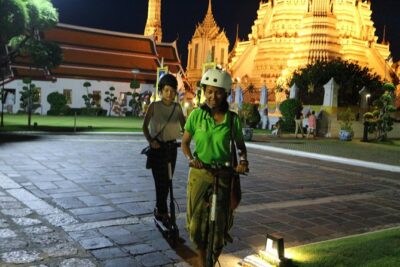
Browse the lists this tour appears in