
Reviewed · BANGKOK STREET FOOD TOURS
Bangkok Hidden Gems: Talad Noi, Chinatown & Street Food Tour
Bangkok’s old Chinese quarter is best understood on foot, one narrow lane and one snack at a time. This tour links Talad Noi’s weathered shophouses and street art with Chinatown’s food stalls, shrines, and busy market streets, giving you a close look at a side of Bangkok that is easy to miss from a taxi.
I like the way the food is part of the route, not an afterthought. You taste turnip cake, chwee kueh, duck noodle soup, and pad Thai while learning how Thai and Chinese cooking meet in this part of town. I also like the small-group format, capped at 12 people, since guides such as Nana, Pam, Gof, and Dong have been praised for personal help and clear local stories.
The main drawback is that this is a walking tour through crowded, uneven areas, and the meeting point is not inside Chinatown itself. The published route lasts about 2 hours 30 minutes and covers 2 kilometers, but crowds, rain, food stops, or a changing route can affect the pace.
In This Review
- Key points before you book
- Why Talad Noi makes a better starting point than Chinatown
- Holy Rosary Church and Talad Noi’s mixed heritage
- Street food with a local guide
- Chow Sue Kong Shrine and the quiet side of Chinatown
- Hong Sieng Kong and a riverside change of pace
- Crossing into Chinatown after dark
- What the small group adds
- Timing, walking, and the real value of $42.48
- Who will enjoy this Bangkok walking tour
- Small details that can make the outing easier
- Should you book the Talad Noi and Chinatown tour?
- FAQ
- Where does the tour start?
- What time does the tour begin?
- How long is the tour?
- What food is included?
- Can vegetarians join?
- How many people can join?
- What happens if a scheduled site is closed?
Key points before you book
- Start with Talad Noi at 4 pm: The late-afternoon timing brings cooler light and leads naturally toward Chinatown after dark.
- Food tastings are included: Expect Thai, Chinese, and fusion bites, including turnip cake, chwee kueh, duck noodles, and pad Thai.
- See more than market stalls: Holy Rosary Church, Chow Sue Kong Shrine, Sol Heng Tai Mansion, local art, and a riverside café add variety.
- Small groups matter here: With a maximum of 12 people, your guide can help with food choices, questions, and crowd navigation.
- Plan for 2 kilometers of walking: You will move through narrow lanes, markets, and busy streets, with time spent standing at food stops.
- Vegetarian requests need notice: Vegetarian food can be arranged if you provide the information at least 24 hours ahead.
Why Talad Noi makes a better starting point than Chinatown
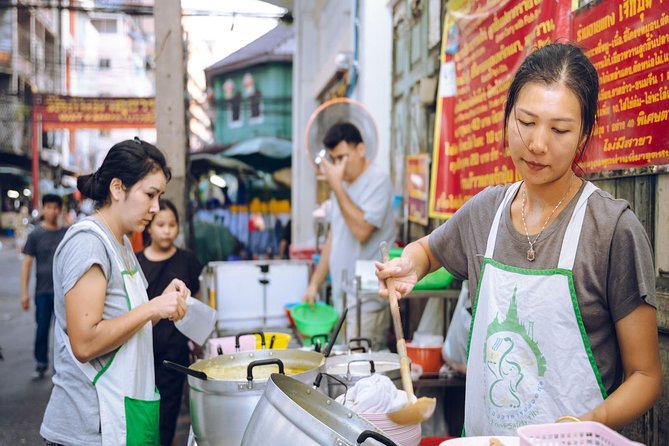
Many first-time visitors head straight to Yaowarat Road, Chinatown’s famous main strip. That is exciting, but it can also be loud, crowded, and hard to read. Talad Noi gives you a slower introduction, with narrow lanes, old homes, small workshops, religious buildings, and bits of public art tucked among everyday Bangkok life.
The neighborhood has been home to Chinese communities for more than 300 years. You are not simply walking past old walls. You are seeing how Chinese settlement, Thai city life, Portuguese Catholic influence, and modern art occupy the same few blocks.
The tour begins at River City Bangkok, at Gate 1, in front of Starbucks on the first floor. The meeting point is near Si Phraya Pier, but it is not directly in the center of the walking route. Give yourself time to find the entrance, especially if you are coming through Bangkok traffic.
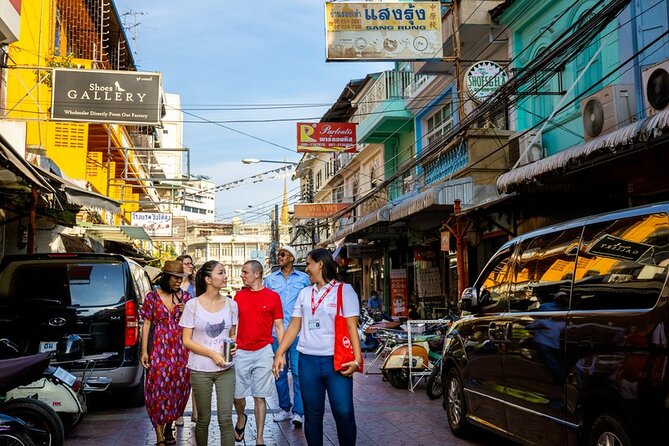
From there, your guide leads you into Talad Noi’s smaller lanes. This is where a local guide earns the fee. A map can show you the streets, but it will not explain which shrine matters to local residents, why a building looks out of place, or where a food sample fits into the neighborhood’s story.
More street food tours in Bangkok:
- Bangkok: Backstreets Food Tour with 15+ Tastings
★ 4.9 · 2,880 reviews - Bangkok Backstreets Food Tour with 15+ Tastings
★ 5.0 · 1,926 reviews - Bangkok: Michelin Guide Street Food Tour by Tuk Tuk
★ 4.4 · 1,274 reviews
Holy Rosary Church and Talad Noi’s mixed heritage
Holy Rosary Church is one of the route’s most striking changes of scene. Founded in 1787, it is a European-style Roman Catholic church built in the Gothic Revival style by Portuguese settlers.
The church helps explain why Bangkok’s old river districts feel so layered. Chinese communities, Portuguese settlers, Thai religious traditions, and river trade all left their mark here. The stop is scheduled for about 15 minutes, so expect a short visit rather than a long architectural tour.
After the church, the route turns back toward Talad Noi’s street art and local lanes. The art gives the area a more current feel, but the appeal is the contrast. Painted walls sit beside aging façades, tangled utility lines, old signs, and homes that still appear to be part of ordinary neighborhood life.
I would not book this outing expecting a polished sightseeing district. Talad Noi is interesting because it feels lived in. You may need to pause, look carefully, and accept that some streets offer small visual details rather than one grand attraction.
Street food with a local guide
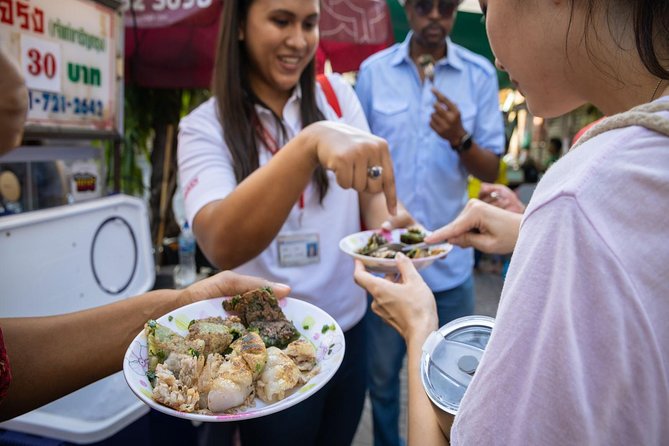
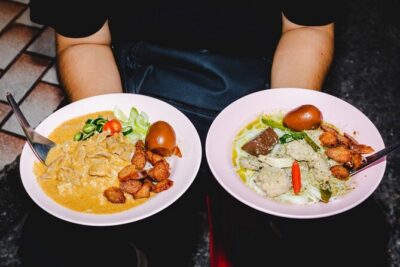
Food is the heart of this experience. The samples are included, and the route is designed to introduce you to foods you may not spot or feel confident ordering alone.
The advertised samples include:
- Turnip cake, a Chinese dim sum dish
- Chwee kueh, a steamed rice cake served with preserved radish
- Chao Tha duck noodle soup
- Pad Thai from Uncle Pom
The exact stops can change. Food stalls may close, and the route can substitute another place. That flexibility is useful in Bangkok, where opening hours and daily conditions are not always predictable.
You are tasting small portions rather than sitting down to a full restaurant meal. This lets you try several styles in a short time, though it also means the experience may feel more like a progressive snack walk than dinner. Some people will want another meal afterward, especially if they have a large appetite.
A good guide makes the difference. Nana has been singled out for keeping the group engaged, helping with food choices, answering questions, and adding practical suggestions for the rest of your stay. Pam has also been praised for being caring and making sure the group had enough to eat.
Vegetarians can be accommodated if you provide the request at least 24 hours before the tour. Other dietary needs are not listed as available, so you should not assume that allergies or special diets can be handled.
Chow Sue Kong Shrine and the quiet side of Chinatown
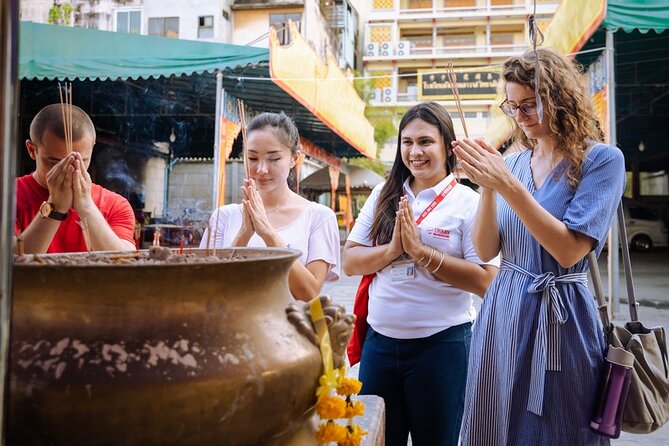
After eating, you visit Chow Sue Kong Shrine, a Hokkien shrine more than 200 years old. The stop lasts about 15 minutes and offers a calm pause between the food lanes and the heavier traffic of Chinatown.
You can ask for blessings connected with well-being, protection, and guidance. The visit is not presented as a formal religious class, but your guide can help you understand what you are seeing and how to behave respectfully.
The shrine is valuable because it shows that Chinatown is not only a shopping and eating district. Faith, family tradition, and neighborhood identity remain part of the streetscape. Keep your voice low and follow any instructions about where to stand or what not to touch.
The route may also pass Sol Heng Tai Mansion, one of Bangkok’s remaining traditional Chinese houses. This is a useful reminder that the district once contained more private residences and family compounds, not just commercial rows.
The itinerary lists the mansion as a brief stop between the shrine and the riverside café. Because the schedule is compact, you may see it from outside or receive a short explanation rather than a long interior visit.
More Bangkok highlights tours:
- Bangkok: City Highlights Temple and Market Walking Tour
★ 4.5 · 3,990 reviews - Lopburi Monkey Temple & Ayutthaya Old City Tour From Bangkok
★ 5.0 · 719 reviews - Bangkok City Highlights Tour: Grand Palace & Three Iconic Temples
★ 4.5 · 542 reviews - Private Tour: Best of Bangkok in A Day
★ 5.0 · 515 reviews
Hong Sieng Kong and a riverside change of pace
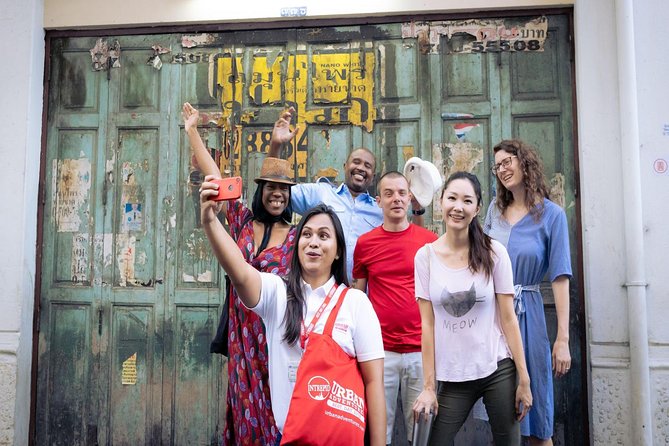
Hong Sieng Kong brings a different mood. The stop combines a local artist’s gallery with a café beside the Chao Phraya River, housed in a building dating from the reign of King Rama II and the Rattanakosin era.
You can relax with coffee or tea here after walking and eating. That pause matters. Bangkok’s heat, humidity, traffic noise, and crowded lanes can wear you down, and a short break keeps the second half of the route enjoyable.
The café also shows how old buildings are being used in new ways. Instead of treating Talad Noi as a museum, the tour points to its current creative side. You get street art, a gallery, old architecture, and food traditions in one compact neighborhood.
Do not expect a long gallery visit or a full river cruise as part of the standard route. Some past outings in this general area have included boat travel, but the supplied tour details focus on the walking route and café stop. Book this experience for the lanes, food, and local context, not for a guaranteed boat ride.
Crossing into Chinatown after dark
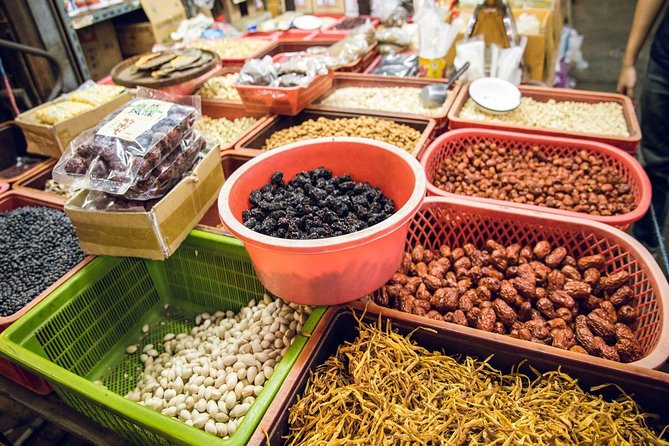
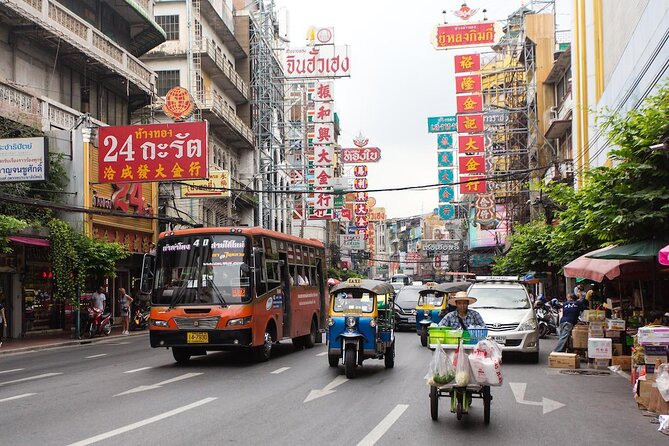
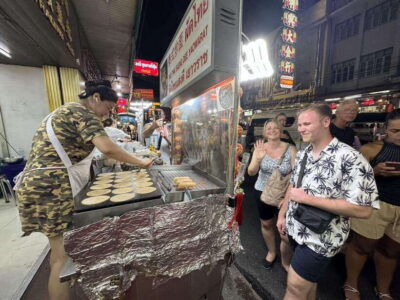
The final stretch takes you into Bangkok’s Chinatown, described as one of the largest Chinatowns in the world. Here, the pace changes. Streets become busier, signs grow brighter, and modern businesses sit beside long-established Chinese shops and food sellers.
The tour gives you a guided introduction rather than a full survey of every market street. You may see stalls selling food, spices, household goods, gifts, and other everyday items. Some routes also include a Chinese coffee shop or flower market, but the core published route ends with Chinatown and Wat Mangkon.
Chinatown is easy to find but not always easy to understand. Streets can look similar, and crowds can split a group quickly. This is where the small group and guide support are useful. One guide, working with a group during Chinese New Year, was praised for keeping everyone together in heavy crowds.
At the same time, the market streets may feel repetitive if you are hoping for a long list of major sights. One visitor found there was little time to stop at individual stalls, while another felt the shopping areas did not require a guide. You should see the tour as a guided orientation and food walk, not as dedicated shopping time.
The listed endpoint is connected with River City Bangkok, while the route details also describe finishing near Wat Mangkon, with help returning to the city center. Wat Mangkon MRT station is a useful connection after Chinatown. Confirm the exact end point with your guide on the day, particularly if you need to meet a taxi or make a dinner reservation.
What the small group adds
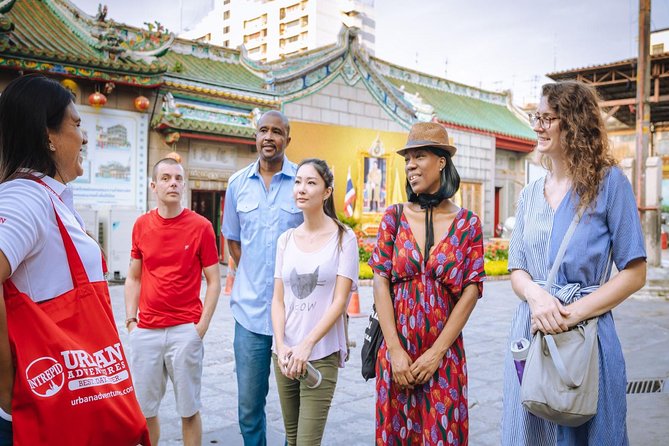
The tour allows up to 12 people, but several outings have been much smaller, including groups of three, four, or five. That changes the feel of a walking tour in a practical way.
A small group makes it easier to hear explanations in narrow streets. You can ask about a dish, request help choosing food, or slow down briefly for a photograph without holding up a large crowd.
The guide can also respond to conditions. Rain has forced route changes, and guides such as Dong have helped with plastic raincoats. Crowds around holidays or royal events can close streets and alter the balance between sightseeing and food.
English ability can vary by guide. Nana and Pam have been praised for clear communication, while some people found language differences made explanations harder to follow. The strongest guides bring warmth, local knowledge, and practical care, but you should keep an open mind about how detailed the commentary will be.
Timing, walking, and the real value of $42.48
At $42.48 per person, the tour is not the cheapest way to walk around Chinatown. You can explore the streets independently for little money, and individual snacks are inexpensive.
The price makes more sense if you value several included tastings, a small group, and a guide who can connect the food to the area’s Chinese, Thai, Portuguese, and modern influences. It also saves you from guessing what to order in unfamiliar stalls.
The published duration is about 2 hours 30 minutes, with roughly 2 kilometers of walking. That is manageable for most people who are comfortable walking and standing, but the route may feel tiring in heat, rain, or dense crowds. Wear shoes with a good grip and bring water, even though the distance is modest.
The 4 pm start is well chosen. You begin in the late afternoon, take a café break, and reach Chinatown as the evening atmosphere develops. Still, do not build a tight evening plan around the exact finish time. Food service, traffic, weather, and road closures can all slow the route.
The minimum age is 8. Most people can take part, but this is not a good match for anyone who has trouble walking or standing for extended periods. A tuk-tuk tour may be a better choice if you want less walking, and taking both tours could cover much of the same old Bangkok territory.
Who will enjoy this Bangkok walking tour
I would recommend it most to first-time visitors who want a guided introduction to Talad Noi and Chinatown without spending a full day on formal sightseeing.
It suits you if you:
- Like trying unfamiliar street food
- Want context for old neighborhoods and religious sites
- Prefer a small group to a large coach
- Enjoy walking through ordinary city streets
- Want suggestions for other places to eat and visit
- Are comfortable with a flexible route
It is less suitable if you want a major temple tour, extensive shopping time, a guaranteed boat trip, or a sit-down dinner. It may also disappoint you if you dislike crowds or want every minute planned around famous landmarks.
The guide’s final tips are useful. You can ask where to eat next, what else to see, and how to get back toward the city center. That personal advice can be worth as much as another food sample, especially early in your Bangkok stay.
Small details that can make the outing easier
Arrive early at River City Gate 1. The location is near public transport and Si Phraya Pier, but large commercial buildings can take time to navigate.
Tell the guide about vegetarian needs at least 24 hours ahead. For other restrictions, ask before booking, since only vegetarian arrangements are confirmed.
Carry light rain protection during Bangkok’s wet months. The route is outdoors, and heavy rain has changed plans in the past. Guides may help with emergency ponchos, but you should not rely on that.
Keep your hands free. You will be walking through narrow lanes, stopping for food, and moving through crowds. A small bag is easier than a bulky backpack.
The operator offers free cancellation up to 24 hours before the 4 pm start for a full refund. Changes or cancellations within 24 hours are not accepted for a refund.
Should you book the Talad Noi and Chinatown tour?
Book it if you want a friendly, food-led introduction to two of Bangkok’s oldest districts and prefer a guide to point out details you would likely pass alone. The best part is the combination of small-group attention, included Thai and Chinese samples, and sharply different sights such as Holy Rosary Church, Chow Sue Kong Shrine, street art, and a riverside café.
Skip it if you mainly want shopping time, grand temples, or a long meal. The route is short but active, and Chinatown can feel repetitive when crowds close streets or limit time at individual stalls.
For a first Bangkok afternoon, the tour offers good value when you count the food, guide, and local orientation together. Just arrive ready to walk, eat small portions, adapt to the weather, and let the neighborhood provide the surprises.
FAQ
Where does the tour start?
Meet your English-speaking guide at River City Bangkok, 23 Soi Charoen Krung 24, at Gate 1 in front of Starbucks on the first floor. The meeting area is near Si Phraya Pier.
What time does the tour begin?
The scheduled start time is 4 pm.
How long is the tour?
The advertised duration is approximately 2 hours 30 minutes, with about 2 kilometers of walking.
What food is included?
Included samples can include Chinese turnip cake, chwee kueh, duck noodle soup, and pad Thai. The exact food stops may change if a stall is closed.
Can vegetarians join?
Yes. Vegetarian food can be arranged if you provide the request at least 24 hours before the tour date. Other dietary requirements are not listed as available.
How many people can join?
The maximum group size is 12 people. Smaller groups may operate depending on bookings.
What happens if a scheduled site is closed?
An alternative site may be visited. If a planned food stall is closed, the guide can choose another street food stop.
More Food Tours in Bangkok
- Bangkok Authentic Tasting Thai-Chinatown Walking Food Tour
★ 4.9 · 852 reviews - Bangkok: Tuk Tuk Adventure Chinatown Michelin Food & Temples
★ 4.3 · 725 reviews - Bangkok Tuk-Tuk Tour by Night with Chinatown Street Food Meal
★ 5.0 · 635 reviews - Bangkok: Must-Try Hidden Bike & Food Experience
★ 4.9 · 613 reviews
More Food and Drink Tours in Bangkok
- Bangkok: White Orchid Chao Phraya Dinner Cruise free Beer
★ 4.4 · 4,573 reviews - Bangkok by Night: Temples, Markets and Food Tuk-Tuk Tour
★ 5.0 · 3,752 reviews - Bangkok Midnight Food Tuk Tuk Tour
★ 5.0 · 2,542 reviews - Old Siam Bangkok Food Tour with 15+ Tastings
★ 5.0 · 867 reviews
Just added around Bangkok
- Yoga in the Park Thailand★ 5.0 · 12 reviews
- Bangkok and Ayutthaya 3 Days★ 4.5 · 12 reviews
- Private Tour: Damnoen Saduak Floating Market and Bangkok City Temples★ 5.0 · 12 reviews
- Chinatown (Yaowarat Road) Neon Photoshoot★ 5.0 · 12 reviews
- Ayutthaya Day Tour By Coach and Cruise★ 4.0 · 12 reviews
- Bangkok Suvarnabhumi Airport: VIP Meet & Greet Service (Fasttrack)★ 3.5 · 12 reviews
- Bangkok: Wow Park Interactive Amusement & Science Park★ 4.5 · 12 reviews
- Afternoon Ayutthaya & Ancient Temples at UNESCO site By Road★ 4.5 · 12 reviews
Bangkok Street Food Tours, compared.
Bangkok Backstreets Food Tour with 15+ Tastings
Read our review →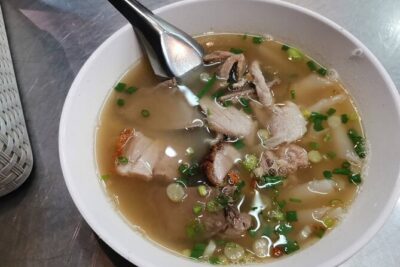
Bangkok Authentic Tasting Thai-Chinatown Walking Food Tour
Read our review →
Tuk Tuk Adventure Chinatown Michelin Food & Temples
Read our review →
Bangkok Tuk-Tuk Tour by Night with Chinatown Street Food Meal
Read our review →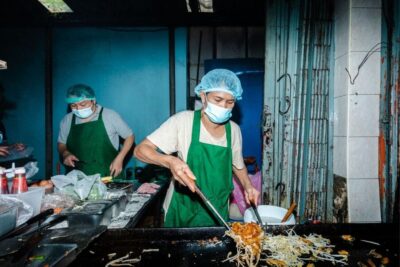
Browse the lists this tour appears in